
Log growing
What to Do After Inoculating Mushroom Logs
8 min read
Once a mushroom log has been drilled, filled, waxed, and labeled, most of the obvious work is finished. The next stage is quieter: keeping the log in a good location while the mycelium spreads through the wood.
This period is usually called colonization or spawn run. Depending on the mushroom, strain, wood, weather, and log size, it can take anywhere from several months to well over a year.
You don’t need to fuss over the logs every day. You do need to protect them from prolonged drying, give them enough airflow, and resist the temptation to force them to fruit before they’re ready.
If you haven’t prepared your logs yet, begin with our guides to choosing and cutting trees and standard sawdust-spawn inoculation.
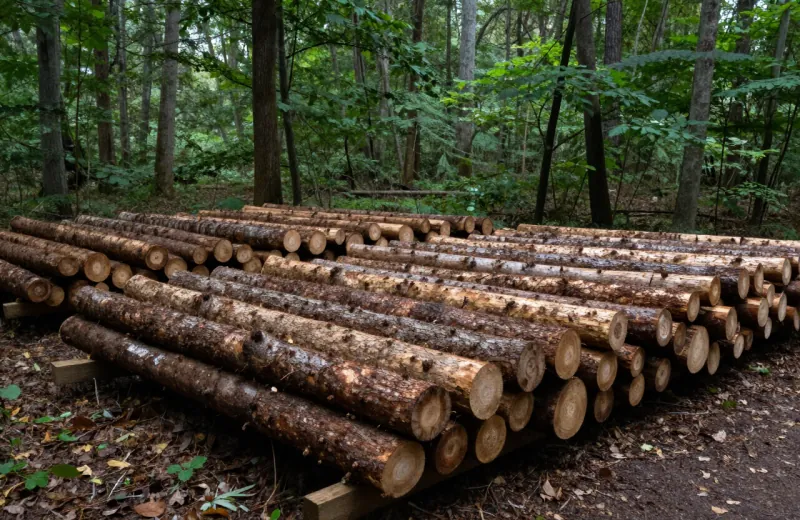
Move the logs into a laying yard
A laying yard is simply the place where inoculated logs spend their time colonizing and, eventually, producing mushrooms.
The best location is:
- Shaded through most or all of the day
- Protected from drying wind
- Humid without being swampy
- Close enough to water that occasional watering is practical
- Accessible after rain and during harvest
- Away from places where logs could roll or create a tripping hazard
A woodland canopy often provides the right conditions naturally. Evergreens offer year-round shade, while deciduous trees may leave logs more exposed during winter and early spring.
Shade cloth can work when natural shade isn’t available. Use material that still allows air to move around the logs. A plastic tarp placed directly over a stack can hold too much heat and surface moisture while also limiting airflow.
The goal isn’t complete darkness. It’s protection from direct sun and the drying that comes with it.
Choose a stable stacking method
Newly inoculated logs can be placed in a loose crib stack, leaned against a support, or arranged in another stable configuration.
A crib stack is made by placing one layer of logs parallel to each other and the next layer across them at a right angle. It works well during colonization because it keeps the pile organized while allowing air to move through it.
Raise the bottom logs slightly with rails, blocks, pallets, or low-value wood. This helps keep the production logs out of constant soil contact and makes the stack easier to inspect.
Don’t pack the logs so tightly that air can’t move between them. At the same time, they don’t need to be spread individually across the woods.
Lean-to and A-frame arrangements make mushrooms easy to see and harvest. They’re often useful during fruiting, but they take more space and aren’t required during the initial spawn run.
Whatever arrangement you use, make sure it’s stable. Mushroom logs are heavy, and a stack can shift as the wood ages.
Moisture matters more than constant watering
The mycelium needs moisture inside the wood, but that doesn’t mean the bark needs to remain wet all the time.
A shaded laying yard with regular rainfall may require very little attention. Dry weather is where management becomes more important—especially with smaller logs, exposed stacks, or wood that naturally loses moisture quickly.
During an extended dry spell, give the logs a thorough watering rather than a light daily mist. A sprinkler or hose can simulate a soaking rain across a larger stack. Let the bark and the space between the logs breathe afterward.
Some growers occasionally submerge colonizing logs for a short maintenance soak. Others depend almost entirely on rainfall and only bring out a sprinkler during unusually dry conditions. There isn’t one schedule that fits every laying yard.
We generally let our logs fruit naturally, and dry weather is one of the main conditions we watch. The practical question isn’t whether the logs were watered on a particular schedule. It’s whether they’ve been allowed to remain severely dry for too long.
Avoid wrapping the stack in plastic to hold moisture. Trapped heat, stagnant air, and constantly wet bark can create a different set of problems.
Keep the labels with the logs
Months after inoculation, one hardwood log looks much like another.
Keep each group labeled with:
- Mushroom species
- Strain
- Tree species
- Inoculation date
Weatherproof aluminum tags are useful, but any durable system is better than relying on memory. You can also mark groups of logs with colored tags or keep a simple map of the laying yard.
Good records become especially valuable when different strains begin fruiting at different times. They help you recognize which combinations are productive under your conditions rather than simply knowing that mushrooms appeared somewhere in the yard.
What colonization may look like
Most of the mycelium grows inside the log, so there may not be much to see for a long time.
As colonization progresses, you might notice pale or whitish growth near the cut ends. It can appear mottled, patchy, or somewhat fuzzy. This may be the cultivated mushroom reaching the end grain, but color alone doesn’t prove which fungus you’re seeing.
Wax may crack, discolor, or get picked away by birds and insects. If it remained in place during the early establishment period, a small amount of later damage doesn’t automatically mean the log has failed.
The bark may also develop lichens, algae, dark staining, or small patches of other fungi. Outdoor logs aren’t sterile, and a few unfamiliar marks on the surface don’t necessarily mean the intended mushroom has been lost.
Try not to scrape the bark or repeatedly cut into the log to check it. Every inspection that damages the bark creates another opening and tells you surprisingly little about what’s happening deeper in the wood.
Signs worth watching more closely
Some surface changes are normal, but a log deserves closer attention if you notice:
- Large areas of bark separating from the wood
- Wood becoming unusually soft, light, or crumbly
- Deep drying cracks combined with a noticeably lighter log
- Extensive fruiting bodies from another wood-decay fungus
- Damage that exposes large areas of bare wood
- A stack remaining constantly wet with poor airflow
- Several logs in one area declining in the same way
Even these signs don’t always provide a simple diagnosis. Several fungi can produce similar colors and textures, and the cultivated mycelium itself may look different as weather conditions change.
When one log looks questionable, separating it from the main stack can make observation easier. There’s usually no need to discard an entire group because of one patch of surface growth.
How long does spawn run take?
There isn’t a dependable countdown that applies to every log.
Oyster mushrooms often colonize faster than shiitake. Under favorable conditions, oyster logs may begin producing within roughly four to twelve months. Shiitake commonly takes around eight to eighteen months and can take longer when the wood is dense, the logs are large, or growing conditions are dry.
Lion’s mane and other wood-growing species have their own timing and may fruit only during a particular season.
A first crop can also be small. Production often improves after the fungus has had more time to establish throughout the log.
The most useful approach is to keep good labels, maintain the laying yard, and watch what happens across multiple seasons. A slow log isn’t necessarily a failed log.
Letting logs fruit naturally
Natural fruiting is the simplest approach and the one we generally use.
Mushrooms often appear after a stretch of rain, a temperature change, or the arrival of the species’ preferred season. Oyster mushrooms can respond quickly to favorable weather. Shiitake strains may fruit in cool, warm, or broad temperature ranges depending on the strain.
Once mushrooms begin forming, check the logs regularly. Small pins can become harvest-sized mushrooms surprisingly quickly, especially during warm, wet weather.
Natural fruiting is less predictable than scheduled production, but it requires less handling and works well when you don’t need mushrooms to appear on a particular date.
When to consider soaking shiitake logs
Fully colonized shiitake logs can be submerged in cool water to encourage a more coordinated flush. This is often called soaking, shocking, or forcing.
Don’t rush it.
Forcing a log before the spawn run is complete uses energy that the fungus still needs for colonization. If you’re new to log growing, waiting for the first natural shiitake flush is a practical sign that the log is capable of fruiting.
A common forcing soak lasts approximately 12 to 24 hours, although timing can vary with temperature, strain, log age, and the grower’s system. After soaking, logs are often moved into a lean-to or A-frame arrangement where developing mushrooms are easy to see and harvest.
Shiitake logs need time to recover after producing a flush. A rest of roughly six to eight weeks is commonly used before another forcing cycle, and some growers wait longer.
This practice applies mainly to shiitake. Oyster, lion’s mane, and many other log-grown mushrooms are usually allowed to respond naturally to rainfall and seasonal conditions rather than being placed on a regular forcing schedule.
Pay attention when mushrooms appear
An inoculated log can still produce mushrooms other than the species you intended to grow. Never assume that every mushroom on or near the stack is edible because the log was inoculated.
Identify each harvest using the mushroom’s full set of characteristics. Don’t rely only on its color, the location where it grew, or a comparison with one photograph.
If you aren’t certain, don’t eat it.
The simple version
After inoculation, place the logs in a shaded, sheltered location with good airflow. Stack them securely, keep them labeled, and prevent prolonged drying without keeping the bark constantly wet.
Then give them time.
Watch the logs during dry weather, pay attention after rain and temperature changes, and let natural fruiting show you when the mushroom is ready. Once well-colonized shiitake logs begin producing, you can decide whether scheduled soaking makes sense for your goals.
Most of the work is happening where you can’t see it. A quiet log can still be a busy one.